
সংবাদ শিরোনাম : The Awami League Without Hasina: Facing Existential Crisis and Fragmentation
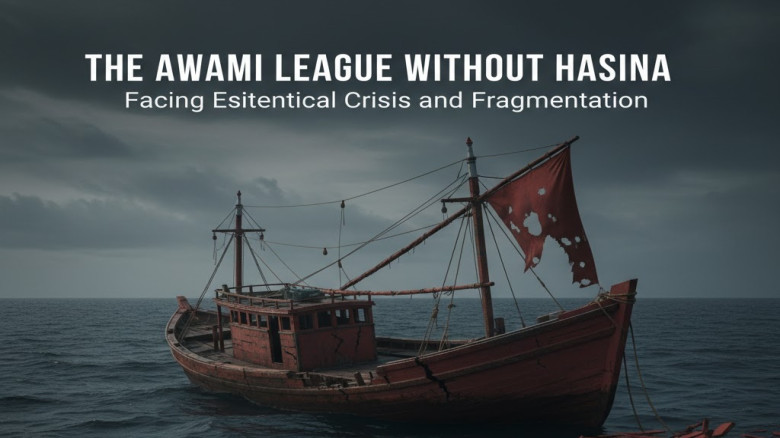
Here is a breakdown of the political future of the Awami League:
1. The Ban and Exclusion from Elections
Banned Status: The Awami League's political activities were formally suspended and banned by the interim government in May 2025, citing national security concerns and alleged past abuses. This ban remains in effect.
Electoral Exclusion: With the ban in place and Hasina convicted, the AL is barred from contesting the upcoming parliamentary elections scheduled for early February 2026. This exclusion of one of the country's two largest parties is a major concern for the legitimacy of the polls, and Hasina's son, Sajeeb Wazed, has warned that the party's supporters will actively obstruct any election held without the AL's participation.
2. Leadership Vacuum and Internal Strife
The party structure is currently in severe disarray:
Figurehead: Sheikh Hasina remains the official President of the Awami League (AL), even in exile. The party is holding meetings in exile (e.g., Kolkata) and continues to take directives from her.
Interim Leader: Obaidul Quader, the General Secretary, is the most visible leader attempting to organize the party's response and maintain its structure, but he lacks the moral and dynastic authority Hasina commanded.
The Mujib Family Question: The long-term future leadership hinges on the Mujib family.
Sajeeb Wazed (Joy): Hasina's son and former adviser is politically active from India, acting as a key spokesperson and strategist. He holds the dynastic claim but is currently unwilling to return to Bangladesh under the current regime, limiting his ability to rally the grassroots.
Fragmentation Risk: Without a unifying, charismatic figure and facing a total ban, the AL is at high risk of fragmentation. Senior leaders and different factions may start vying for control, potentially leading to splinter groups or a weakened core that is incapable of sustained, organized resistance.
3. Strategy from Exile: Political Confrontation
The Awami League's immediate strategy, articulated by its leaders in exile, is one of aggressive confrontation and non-cooperation:
Rejecting the Verdict: The party has universally rejected the death sentence, calling it "vengeance politics" and a "travesty of justice" by a politically biased tribunal.
Boycott and Disruption: They have openly stated they will not recognize any election held under the interim government without their participation. This means they are prepared to mobilize unrest and violence to disrupt the electoral process and delegitimize the new government, continuing the confrontational politics Bangladesh is known for.
International Appeal: They are focused on appealing to the international community, particularly to India, to pressure the interim government for a fair, inclusive election and to protect Hasina from extradition.
4. The Political Landscape's Shift
The exclusion of the AL completely changes the national political dynamic:
BNP's Gain: The main opposition, the Bangladesh Nationalist Party (BNP), led by Khaleda Zia, stands to be the primary beneficiary. With the AL out of the race, the BNP is the leading contender for power in the upcoming elections.
Rise of New Forces: The political space is opening up for new parties, including the National Citizen Party, formed by the student-led movement coordinators, and other minor parties, though none have the national footprint of the AL.
End of the Two-Party System: If the AL remains excluded, it marks a temporary, if not permanent, end to the deeply entrenched two-party (AL vs. BNP) political dominance that has defined Bangladesh for the past three decades.
In summary, the Awami League is in a state of crisis—banned, leaderless on the ground, and facing an existential threat to its unity and relevance. Its future depends on its ability to maintain internal cohesion and successfully pressure the interim government to lift the ban before the national elections.